
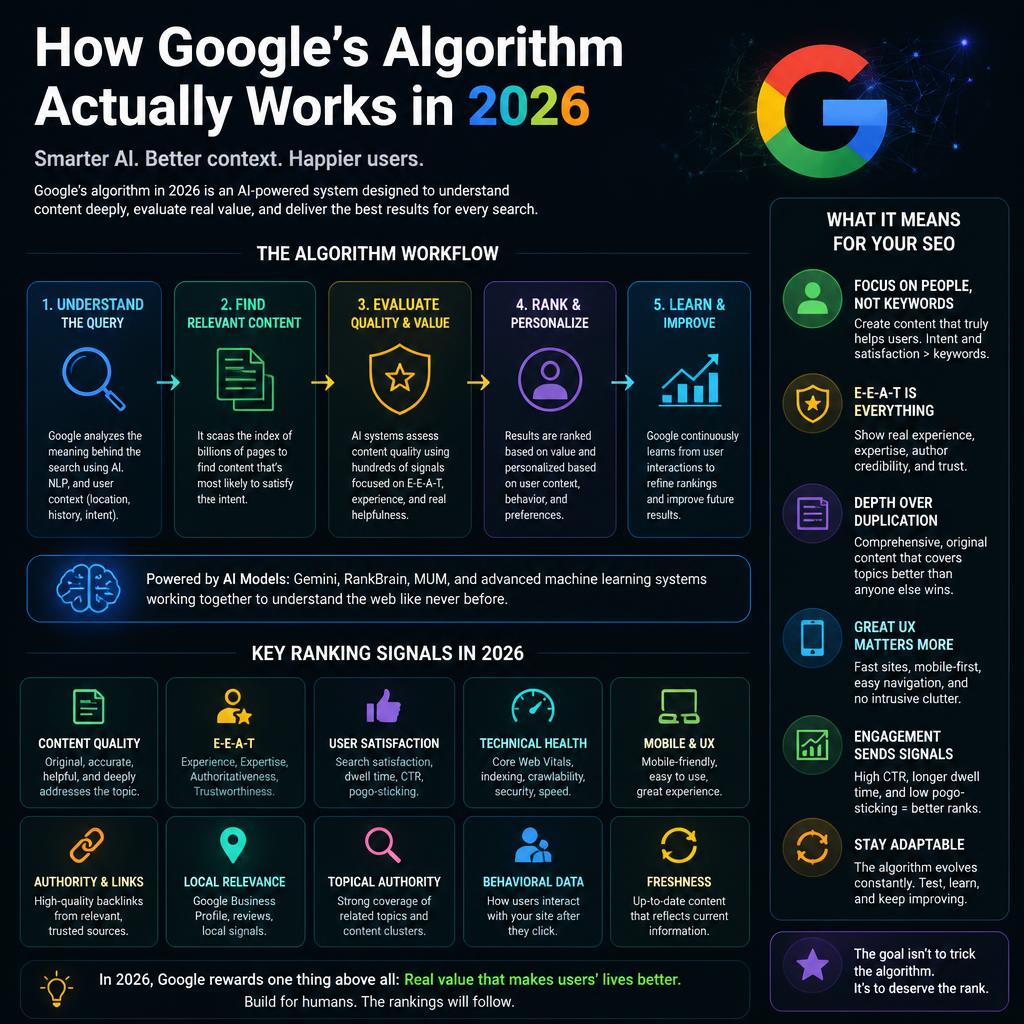
How Google’s Algorithm Actually Works in 2026 And What It Means for Your SEO
If you’ve ever typed something into Google and wondered why certain websites show up first while others are buried on page 5 you’re asking the right question. And honestly, so is every business owner, every marketer, and every person who has ever tried to grow something online.
Google’s algorithm isn’t magic. It’s not random either. It’s a system a very sophisticated, very demanding system and once you understand how it thinks, SEO stops feeling like guesswork and starts feeling like strategy.
This blog breaks the whole thing down. What the algorithm looks for, how it has changed in 2026, what matters most right now, and what you can actually do about it.
What Is Google’s Algorithm Really?
Let’s not overcomplicate it. Google’s algorithm is essentially the set of rules Google uses to decide which pages deserve to rank for any given search. When you type “best bakery near me” or “how to fix a leaking pipe,” Google runs your query through hundreds of filters, signals, and models in a fraction of a second and then serves you what it believes are the most helpful, most trustworthy results.
The reason it feels so mysterious is because Google doesn’t publish the exact formula. They never have. But over years of official statements, patents, leaked documents, and testing by the SEO community, we know a whole lot more than most people realise.
Here’s the simple version: Google is trying to answer one question does this page genuinely help the person who searched for this?
Everything else flows from that.
The Four Stages Every Page Goes Through
Before a single page ranks, it has to pass through four stages. Most people only think about rankings — but the stages before it matter just as much.
Crawling
Googlebot — Google’s web crawler — visits your site to discover your pages. If your pages can’t be crawled because of blocked settings, broken links, or poor site structure, they’ll never make it to search results at all.
Indexing
Once crawled, Google stores the page in its index essentially a giant database of everything it has found on the web. If your page isn’t indexed, it doesn’t exist as far as Google is concerned.
Ranking
This is the stage everyone focuses on. Hundreds of signals come into play here content quality, backlinks, page speed, how well the page matches the search query, and a lot more.
Serving
Google serves the best results for each user based on their location, device, search history, and language. Two people can search the same thing and see slightly different results.
A good SEO strategy works across all four stages not just the third one.
The Core Ranking Signals That Actually Drive Results in 2026
Here’s what Google genuinely pays attention to when deciding where to rank your page.
Search Intent Match
This is the foundation. Everything starts here.
Search intent is simply what the user actually wants when they type something. Are they trying to learn something? Buy something? Find a specific website? Compare options?
Google has gotten extraordinarily good at reading intent. So if someone searches “how to start a digital marketing career,” they want a guide not a sales page for a marketing agency. If someone searches “hire a digital marketing expert in Calicut,” they want a service provider not a blog post.
If your content format doesn’t match the intent of the query, it won’t rank well no matter how good the writing is.
Before you write anything, look at what’s already ranking for your target keyword. That’s Google showing you exactly what kind of content it thinks users want.
Content Quality and E-E-A-T
E-E-A-T stands for Experience, Expertise, Authoritativeness, and Trustworthiness. Google added the first E for Experience back in 2022, and in 2026 it carries more weight than ever.
The idea is this: Google doesn’t just want expert content. It wants content written by someone who has actually done the thing they’re writing about. A guide on running Facebook ads is more credible if it comes from someone who has run Facebook ad campaigns for real clients. A blog about SEO in Calicut is more trustworthy if it’s written by someone who actually operates in that market.
This matters enormously for local businesses in Kerala. The experience you bring to your work the results you’ve produced, the clients you’ve helped, the problems you’ve solved that’s your E-E-A-T. Documenting it well is SEO strategy.
If you’re searching for the best digital marketing expert in Calicut, this is the question to ask: can they demonstrate real experience with real results? Because that’s exactly what Google rewards — and what any serious client should look for.
Backlinks
Backlinks links from other websites pointing to yours remain one of Google’s most important ranking signals. The reason is simple. A link from another website is essentially a vote of confidence. Google reads it as: this site thinks this page is worth referencing.
But here’s what changed over the years: it’s not about volume anymore. One link from a respected news site, a well-known industry blog, or a genuine Kerala business directory is worth more than fifty links from random, low-quality websites.
Buying links, joining link farms, or using sketchy link-building services is also a very fast way to get penalised. Google’s spam detection has become sharp enough to catch most of it.
Build links the old-fashioned way: create content worth linking to, contribute genuine guest posts, get featured in local directories, and build relationships within your industry.
Core Web Vitals and Technical Performance
In 2026, page experience is a confirmed ranking factor. Google measures this through Core Web Vitals three specific technical metrics.
LCP or Largest Contentful Paint measures how quickly the main content of your page loads. It should be under 2.5 seconds. INP or Interaction to Next Paint measures how quickly your page responds when a user clicks or taps something. It should be under 200ms. CLS or Cumulative Layout Shift measures whether your page jumps around as it loads that’s incredibly frustrating on mobile. It should be under 0.1.
A slow, jumpy website loses rankings and more importantly, loses users. Google knows that if people are clicking back to search results immediately after visiting your page, something is wrong.
Mobile-First Everything
Google has used mobile-first indexing as its default for years now. This means it primarily looks at the mobile version of your website when deciding how to rank it.
If your desktop site looks great but your mobile experience is clunky, that’s the version Google is judging. In a country like India where the majority of internet traffic comes from smartphones, this isn’t just an SEO issue it’s a business issue.
What the 2025–2026 Algorithm Updates Changed
The last 18 months saw Google run several significant updates that reshaped the SEO landscape in meaningful ways.
The AI Content Crackdown
Google didn’t ban AI-generated content. But it got very aggressive about punishing AI content that lacks originality, human perspective, and genuine value. Websites churning out hundreds of templated, low-effort AI articles saw dramatic ranking drops.
The lesson wasn’t don’t use AI. The lesson was: AI content without human editing, real insight, and authentic perspective will be treated like spam. Use AI as a tool, not as a replacement for actual thinking.
The Helpful Content System
Google’s helpful content system has been refined continuously and now applies sitewide. One section of low-quality, clearly SEO-driven content can pull down the rankings of otherwise good pages on the same site.
The question it asks of every page: would this content exist if search engines didn’t exist? If the only reason the page was written was to rank it’s going to struggle.
Local Search Updates
In 2026, Google’s local search results are more competitive than ever. For businesses in cities like Calicut, Kozhikode, and across the Malabar coast, local SEO has become the most direct path to online visibility.
The local algorithm weighs three main factors: proximity, which is how close the business is to the searcher; relevance, which is how well the business matches the query; and prominence, which is how well-known and well-reviewed the business is online.
A strong Google Business Profile, consistent business information across directories, regular posts, genuine customer reviews, and local backlinks these are what separate the businesses that show up on Google Maps from the ones that don’t.
Technical SEO The Silent Killer Most Businesses Ignore
You can have the best content on the internet. If your site has technical problems, it won’t rank.
Crawl errors are pages that Googlebot can’t access because of broken links, wrong robots.txt settings, or server errors. Check Google Search Console regularly it will flag these.
Duplicate content means multiple pages on your site with the same or very similar content, which confuses Google. It won’t know which one to rank. Use canonical tags to tell Google which version is the main one.
A missing or incorrect sitemap means Google struggles to find all your important pages. Submit yours in Google Search Console and keep it updated.
No HTTPS means you’re flagging yourself as insecure to both Google and your visitors. Sort this immediately.
Unoptimised images are one of the most common reasons for slow load times. Compress everything and use modern formats like WebP.
Broken internal links damage user experience and waste your crawl budget.
None of these are glamorous fixes. But they matter more than most people think.
How to Actually Rank in 2026 A Practical Checklist
Here’s the reality: ranking on Google in 2026 is both harder and more achievable than it’s ever been. Harder because the bar for quality is higher. More achievable because most of your competition still isn’t meeting that bar.
Research search intent before writing anything — look at what’s ranking and why.
Write content that demonstrates real experience — actual results, actual examples, your real perspective.
Target one primary keyword per page, used naturally across the title, first paragraph, subheadings, and conclusion.
Use internal links to connect related content across your site.
Build backlinks through genuine outreach, guest posts, and being worth referencing.
Optimise your Core Web Vitals — run PageSpeed Insights and fix what it tells you.
Make sure your site is fully functional on mobile.
Set up and regularly update your Google Business Profile.
Get listed in reputable local directories including Justdial, Sulekha, and local Kerala business portals.
Ask satisfied customers to leave Google reviews — and respond to every single one.
Track everything in Google Search Console — impressions, clicks, top queries, and technical issues.
Local SEO in Calicut — Why It Matters More Than Ever
Calicut — or Kozhikode, as we know it — is one of the most commercially active cities in Kerala. Healthcare, education, retail, real estate, professional services — every sector is fighting for visibility online now. And the businesses that understand local SEO are pulling ahead fast.
The shift happened quietly over the last few years. Customers who used to rely on word-of-mouth or driving past a shop are now searching first. “Digital marketing agency in Calicut.” “Chartered accountant near me.” “Best restaurant in Kozhikode.” If your business doesn’t show up for those searches — a competitor’s does.
Local SEO isn’t a separate strategy. It’s an integrated part of how you show up on Google — in the map results, in the local pack, and in organic search results for location-specific queries.
For any business operating in this region, working with the best digital marketing expert in Calicut who understands both the algorithm and the local market is one of the highest-leverage investments you can make. Not because SEO is a magic trick. But because your customers are already searching — and the only question is whether they find you or someone else.
The Honest Summary
Google’s algorithm isn’t your enemy. It’s a judge with very specific standards — and those standards, at their core, are actually reasonable. Create genuinely useful content. Be technically reliable. Be trustworthy. Match what your audience is looking for.
The businesses and creators who approach SEO with that mindset — not as a hack, but as a genuine investment in quality — are the ones who build rankings that hold up through every algorithm update.
For businesses in Calicut, Kozhikode, and the broader Malabar region, the opportunity is significant. Most of your local competitors haven’t figured this out yet. The ones who do — and who work with the right experts to execute it — are going to own their categories online.
That window won’t stay open forever.
About the Author
Muhammed Zidan PT is a digital marketing strategist based in Kozhikode, Kerala. He specialises in SEO, performance marketing, and building online visibility for businesses targeting both local and GCC markets. Follow him on Instagram at @itszidaan.pt or connect on LinkedIn at linkedin.com/in/zidanpt
Have questions about your SEO strategy or want to know exactly where your website stands? Get in touch — let’s talk about what it would actually take to rank.
+